How Do You Scope a Multi-Site Historian Migration Before Moving a Single Record?
Large historian environments contain thousands of tags distributed across multiple sites, services, and process areas. Identifying the right tags, organising migration batches, and eliminating duplicate entries manually introduces error and consumes significant engineering effort before a single record has moved.
eDNA2Canary provides a dedicated Migration Planning Workspace that enables engineers to discover historian tags from eDNA, organise them into migration lists, filter assets by site or service, map sites to destination datasets, and prepare controlled migration batches before any historical data is transferred. The migration is scoped and validated before it begins — not discovered mid-execution.
What Happens to 10 Years of Inconsistent Tag Names When You Migrate to Canary?
Historian environments that have evolved over many years almost always contain inconsistent naming conventions. Migrating those conventions directly into a modern historian reproduces the problem rather than resolving it. Standardising them manually significantly increases project effort and introduces unnecessary risk.
eDNA2Canary incorporates an Intelligent Tag Transformation Engine that enables engineers to configure, preview, and apply rule-based tag transformations before migration begins. The software supports configurable, ordered, site-specific rename rules with live previews — naming standards are validated prior to execution, and flexibility is maintained across different sites and operational environments.
How Do You Run a Historian Migration Without Touching Production Systems?
Migrating years of operational history requires the ability to control migration windows, manage metadata, resume interrupted migrations without restarting completed work, and monitor progress — without disrupting production systems or risking data integrity.
The Migration Execution Console provides a central interface for configuring migration timeframes, controlling metadata migration, initiating validation processes, and monitoring execution progress in real time. Live statistics including migrated records, processing rates, elapsed time, remaining workload, and migration status give engineers complete operational visibility throughout. Interruptions do not mean restarts — resumable migration management preserves every completed step.
What Does Real-Time Visibility Look Like During a Large-Scale Migration?
Large-scale historian migrations execute over extended periods. Without continuous operational visibility, identifying performance bottlenecks or understanding where the migration actually stands becomes increasingly difficult — and recoveries become guesswork.
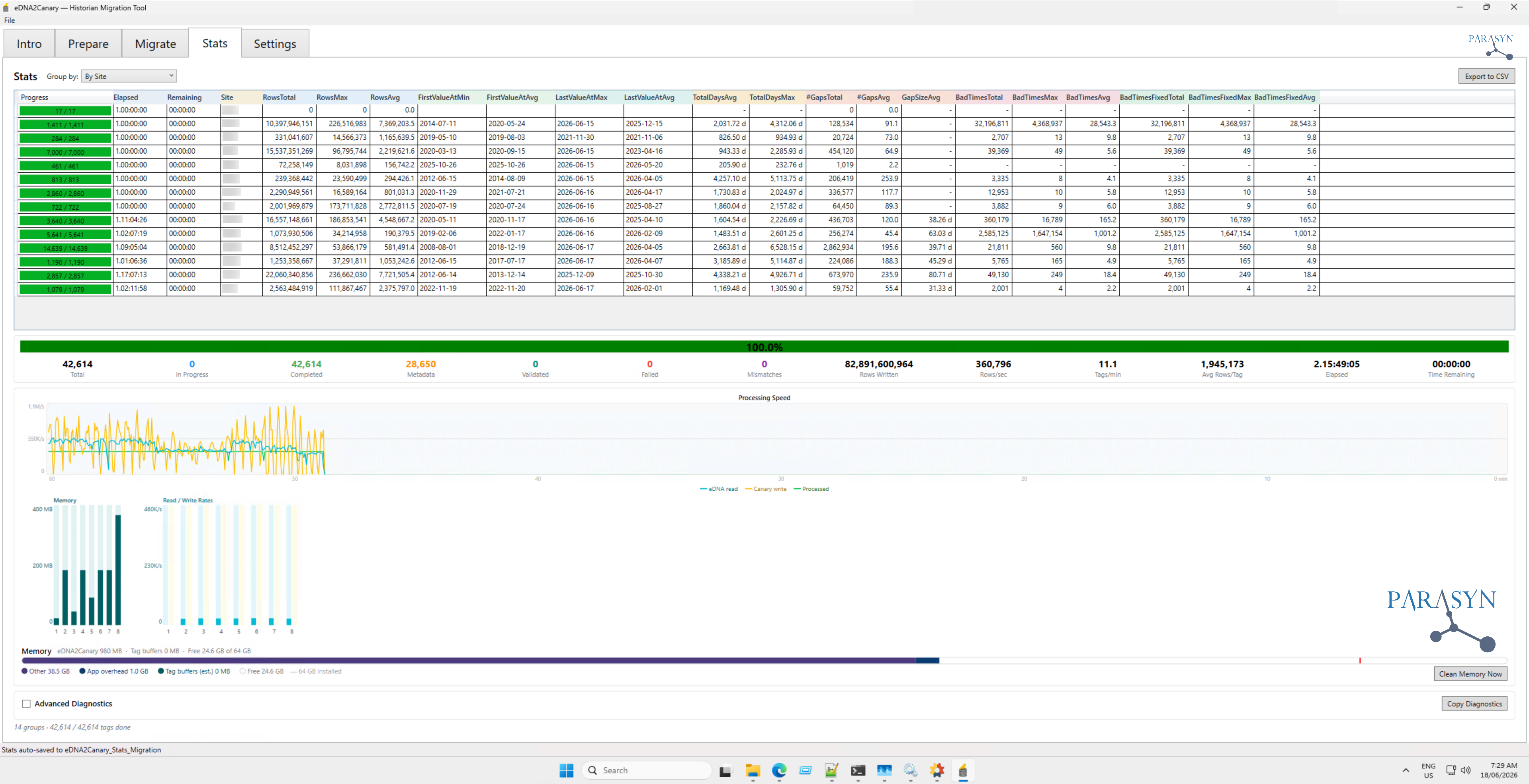
eDNA2Canary continuously captures operational metrics throughout the migration process, presenting engineers with real-time dashboards reporting migration throughput, processed records, completed datasets, processing speed, memory utilisation, and overall progress. Engineering decisions are informed by live data, not estimates.
What Engineering Evidence Proves a Historian Migration Is Complete and Auditable?
Successfully moving data is not the same as proving it moved correctly. Engineering teams require objective evidence demonstrating project progress, migration performance, and completion — evidence that survives a review, an audit, or a warranty claim.
eDNA2Canary automatically generates comprehensive migration statistics and performance summaries including processed tags, migrated records, execution duration, processing throughput, completion status, and validation results. Detailed operational logs are recorded throughout, supporting troubleshooting, engineering review, auditability, and future migration activities.
eDNA2Canary: Built for Industrial Historian Migrations
- Intelligent migration planning and tag discovery across multi-site eDNA environments
- Configurable tag transformation and rename engine with live preview and site-specific rules
- Controlled, staged migration execution with configurable timeframes and metadata management
- Resumable migration with persistent progress tracking — no restarts after interruption
- Real-time migration KPIs and performance analytics throughout execution
- Automated migration reporting and operational logging for audit and engineering review
- Built-in migration validation and metadata support
- Designed and proven for large-scale industrial historian migrations
Your Legacy Historian Has a Migration Path
Successful historian migration requires structured planning, automation that removes human error, resumable execution, real-time monitoring, statistical reporting, and complete engineering visibility. eDNA2Canary delivers all of it in a single, purpose-built environment — because the gap between a consultant’s recommendation and a completed, validated migration is where projects fail.
Parasyn developed eDNA2Canary during a live industrial engagement and continues to maintain and extend it. If you are managing legacy historian infrastructure and need a governed migration path, talk to us. The same framework that migrated eDNA to Canary can be adapted for other historian platform transitions — ask us about old2new by Parasyn.